
Chhath at the Waterline
Four days of fasting, cooking, and ritual at the river. A neighbourhood, not a household, festival.

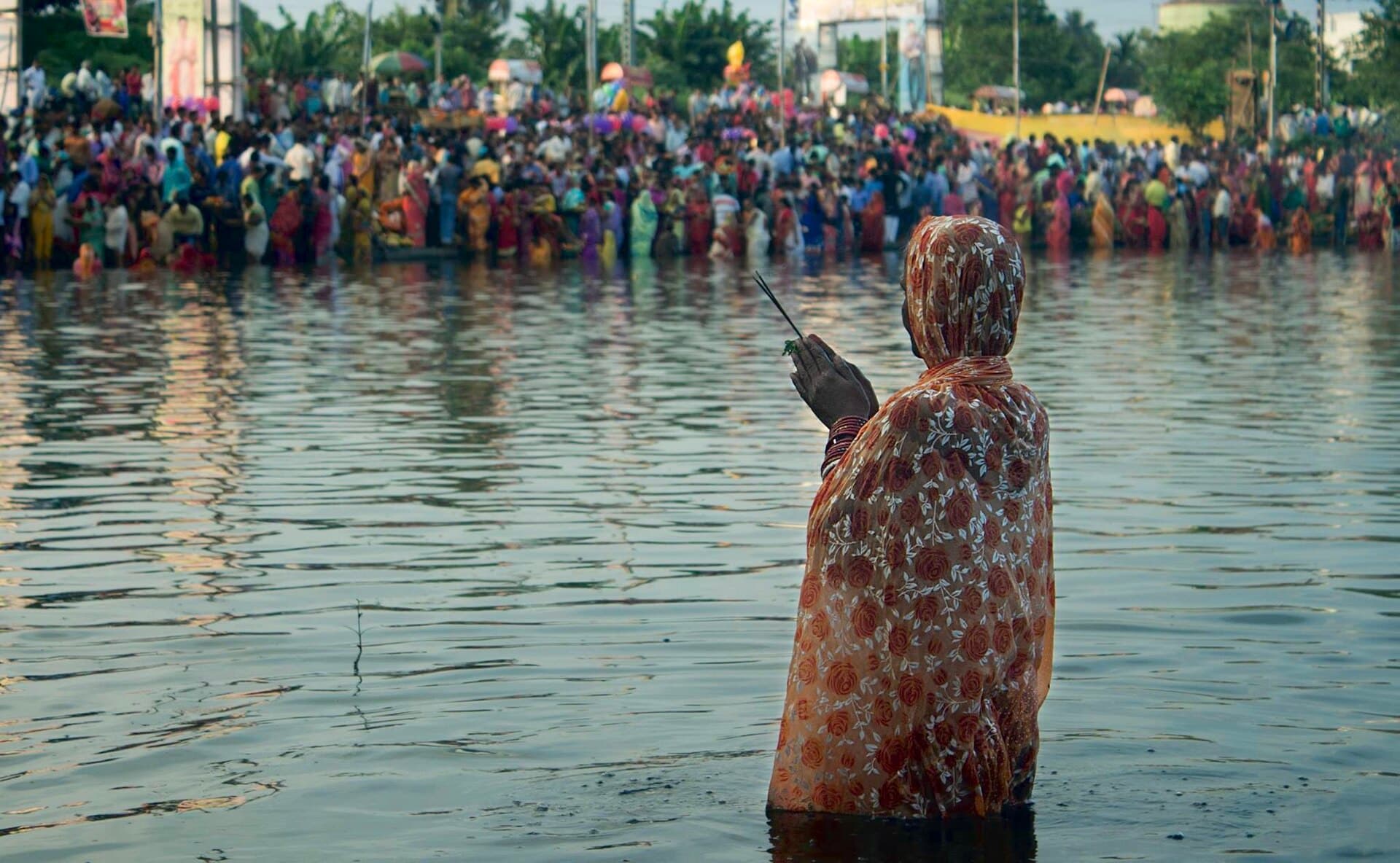
Chhath is not a one-day festival. Its full observance runs across four days in the month of Kartik (October–November), and its shape is unusual in the Hindu calendar. There are no temples involved. No priests as intermediaries. The offerings are made in person, by the fasting woman (vrati) or man, standing in the water at dawn or dusk, to the sun.
The festival begins with Nahay Khay — a day of cleansing, during which the vrati bathes and eats a simple meal of rice and pumpkin, cooked in bronze over a wood fire. The second day, Kharna, brings a longer fast and a single evening meal of kheer made from jaggery. On the third day, the vrati takes no water at all; in the evening, she offers arghya (water poured from cupped hands) to the setting sun at the river. And on the fourth morning, the family returns to the water at first light for the final arghya to the rising sun.
At Dashashwamedh Ghat in Varanasi on the evening of Sandhya Arghya, the crowd is enormous but strangely quiet. Thousands of families sit along the steps with baskets of fruit — coconut, banana, sugarcane, thekua — waiting for the sun to drop low enough. The water is dense with standing figures in wet saris. A woman from Sigra, at her ninth Chhath, told us she had kept the vow every year since her marriage. “My mother did it. My mother-in-law did it. If my daughter keeps it, she will do it. It is ours.”
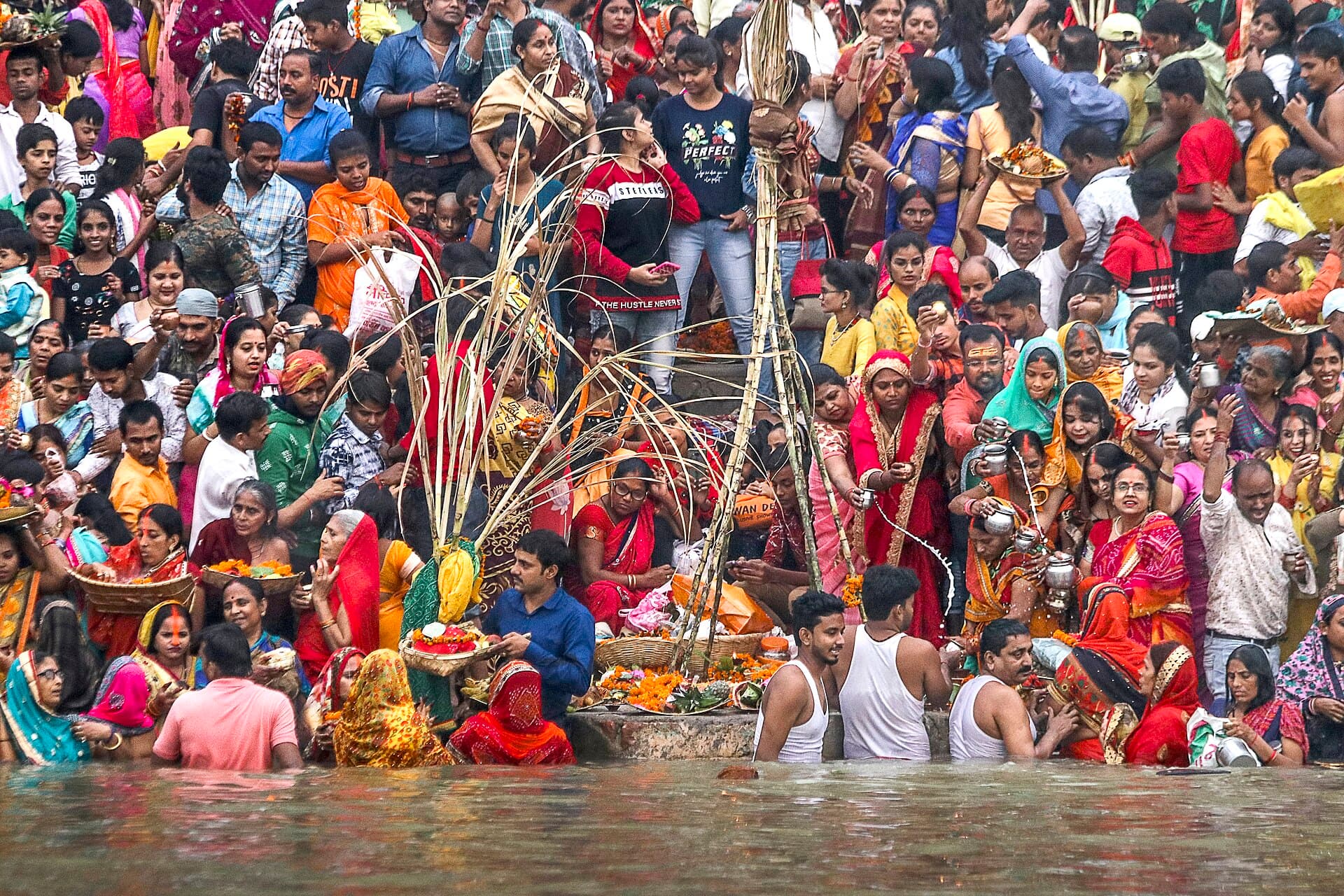
What is striking about Chhath in Purvanchal is its public, neighbourhood character. The festival is not contained within the home; it moves to the water, and the water is shared. Each ghat, each pond, each river embankment becomes a shared stage. In Ballia, the scene is more compressed than in Varanasi — smaller ponds, tighter crowds, a single unbroken wall of sugarcane stalks propped upright along the water's edge. But the structure is the same.
The vrati do most of the visible work. They fast. They cook the prasad with exacting purity rules (no salt in the thekua, no tasting during preparation). They stand in the cold water. But Chhath is also a festival of male participation — husbands, brothers, sons carry the heavy daalas (baskets) to the water, help their fasting women into the river, and hold the offerings.
By the morning after Usha Arghya, most of the families are home by seven. The vrati takes her first food in more than thirty-six hours. The ghats are silent again. The bamboo railings come down. Neighbourhoods go back to their daily work. The river carries on.
Dev Deepawali on the Ghats
A night-long walk along the Ganga on Kartik Poornima, as lamps, rituals, and crowds transform the stone steps into a shared public stage.