
Kajri Season
In the weeks between the first rains and the end of Shravan, the women of the courtyard sing about absence — and the men who have gone to the city.

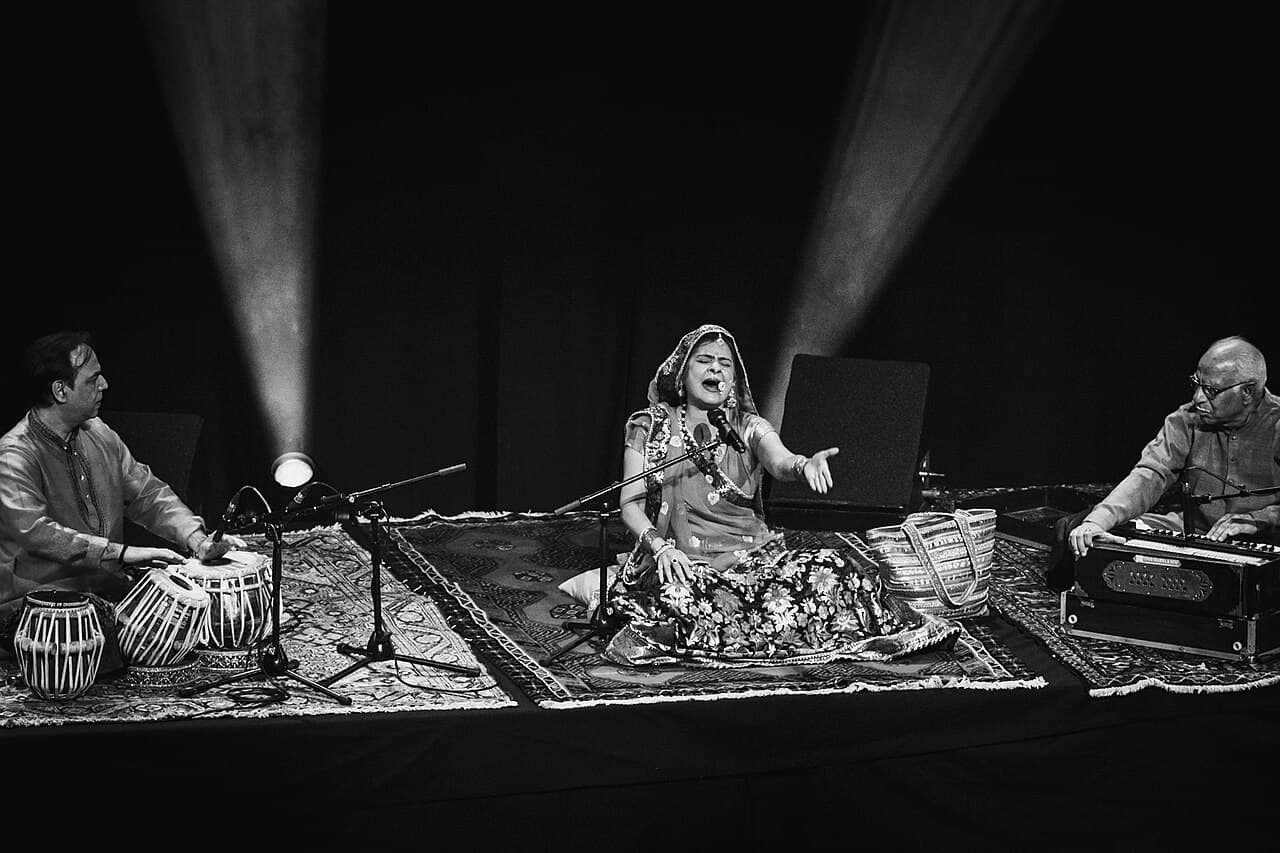
The first Kajri of the season is always slightly tentative. Someone in the courtyard — usually one of the older women — starts the tune, and the others join in when they recognise it. By the third or fourth song, the singing is no longer tentative. It has the authority of long practice.
Kajri is a song of the monsoon. More specifically, it belongs to Shravan (July–August), the Hindu month in which the rains settle in and the green returns to the plains. Across the Bhojpuri-speaking belt — eastern Uttar Pradesh, western Bihar, the Mirzapur hills — Kajri is the sound of Shravan in women's courtyards.
The subject of Kajri is almost always the same. A young woman, recently married, whose husband has left for work — often to Calcutta in the older songs, now to Mumbai or Dubai — and who watches the monsoon clouds gathering over an empty house. The emotion is longing (viraha), sharpened by the rain.
There is a classical Kajri, associated with trained Hindustani singers (Girija Devi's are probably the most famous), and there is folk Kajri, sung in courtyards without training, by women whose mothers and grandmothers sang the same songs. The two traditions have influenced each other but remain distinct.
Mirzapur has its own Kajri — larger, slower, sung in groups, with a mournfulness that can open out into something almost ceremonial. A well-known Mirzapuri Kajri session will run to a hundred women, all singing together. Banarasi Kajri is more ornate, closer to the classical form; the singers of Kabirchaura mohalla maintain this tradition.
What Kajri preserves is a particular way of marking time. The first clouds call for it. The last clouds end it. It cannot be sung out of season — you cannot sing Kajri in December, and no one would try. A whole month of women's song, folded into the calendar between two weather patterns.
Bhojpuri Music: Roots and Rhythms
A primer on the song-forms of Purvanchal — Kajri, Birha, Sohar, Nirgun, Chaita — where they are sung, who sings them, and what they are really about.