
Bhojpuri Music: Roots and Rhythms
Kajri for monsoon, Chaita for spring, Sohar for a newborn, Birha for separation. A primer on the song-forms that still travel across the Bhojpuri belt.

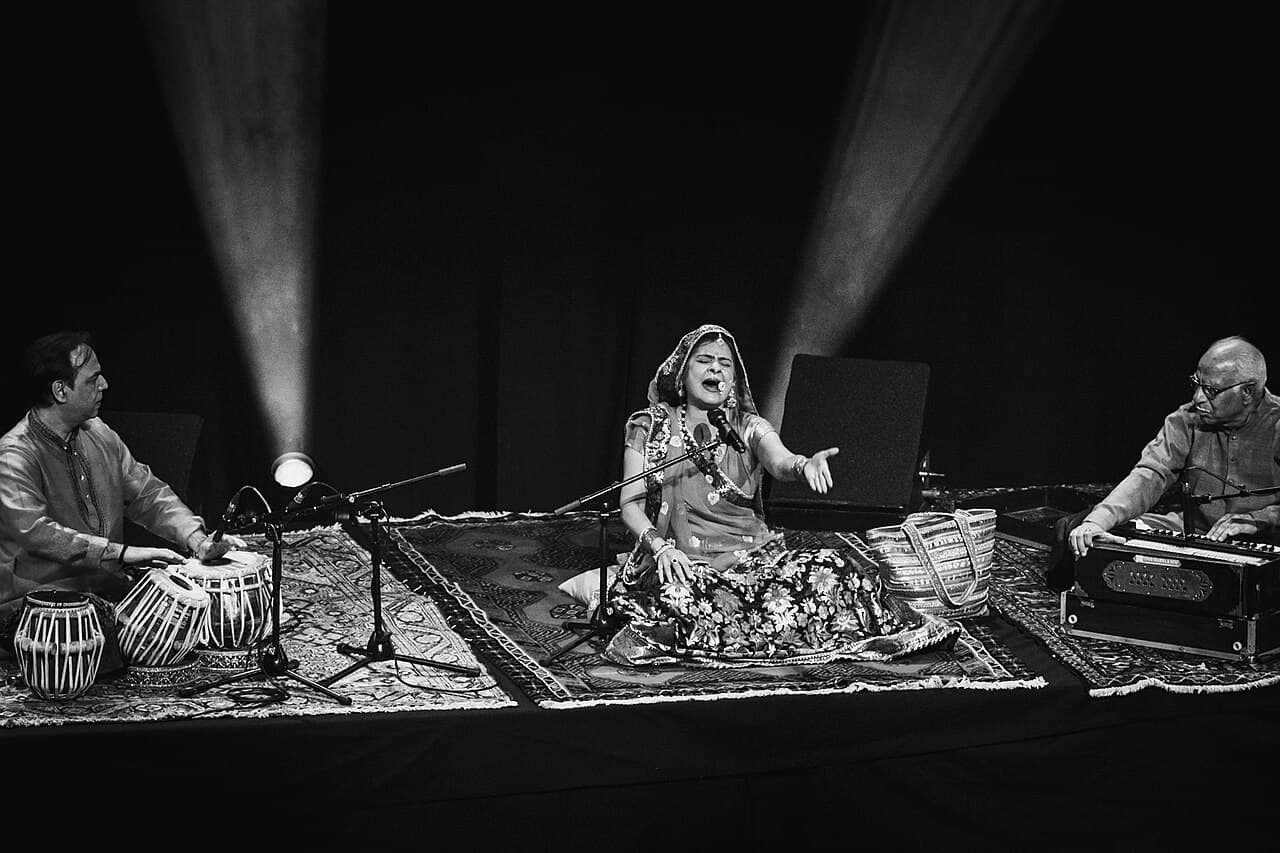
Bhojpuri music is not one music. It is a family of song-forms, each tied to a season, an occasion, a mood, or an ethical argument. A quick primer to help the reading of later essays in this pillar.
Kajri
Kajri belongs to the monsoon. It is sung in the weeks between the first rains and the end of the rainy month of Shravan, and its subject — almost always — is the longing of a woman for an absent husband. The forms are divided between the more ornate Banarasi Kajri associated with classical singers, and the folk Kajri sung in courtyards across the Bhojpuri belt. Mirzapur has its own variant, known for its scale and the women's collective voice.
Birha
If Kajri is about longing, Birha is about separation itself — long narrative ballads, often sung by men, typically in eastern Purvanchal and particularly Ballia. Birha is a performance form more than a household form: a professional singer with a harmonium, a drum, and sometimes a chorus, holding a crowd for an hour or more with a story that may be mythological, historical, or drawn from recent tragedy.
Sohar
Sohar is a welcome song for a newborn, sung by women of the household in the weeks around the birth. The lyrics are structured around well-known scenes — Krishna's birth, Rama's birth — but personalised for the child. It is one of the most persistent women's song traditions in the region.
Nirgun
Nirgun is philosophical — devotional song in the Kabir tradition, addressing the formless divine. It is the most severe of these forms, and the most widespread in the older weaving quarters. Kabir's dohas are still sung, not just read, in households that may otherwise not describe themselves as religious.
Chaita
Chaita belongs to the month of Chait (March–April), as spring moves towards summer. The tone is lighter than Kajri — playful, flirtatious, sometimes mocking. Holi songs (Hori) overlap with Chaita; the line between them is porous.
What these forms share is a grounding in seasonal and domestic time. The singer does not choose the song; the month and the occasion do. The long history of Bhojpuri migration — to Calcutta, to Mauritius, to Suriname, to the Gulf — means that these forms also travel, sometimes changing radically in the process. But in Purvanchal itself, the seasonal structure holds. You still cannot sing Kajri in November.
Kajri Season
Kajri is a song for the monsoon, and the monsoon is a song for women whose husbands have gone away. An essay on one of the great seasonal forms of Bhojpuri music.