
Flavours of Purvanchal
Litti-chokha, thekua, malaiyo, kachori-sabzi — the kitchen of Eastern UP is seasonal, hearth-led, and rooted in community cooking.

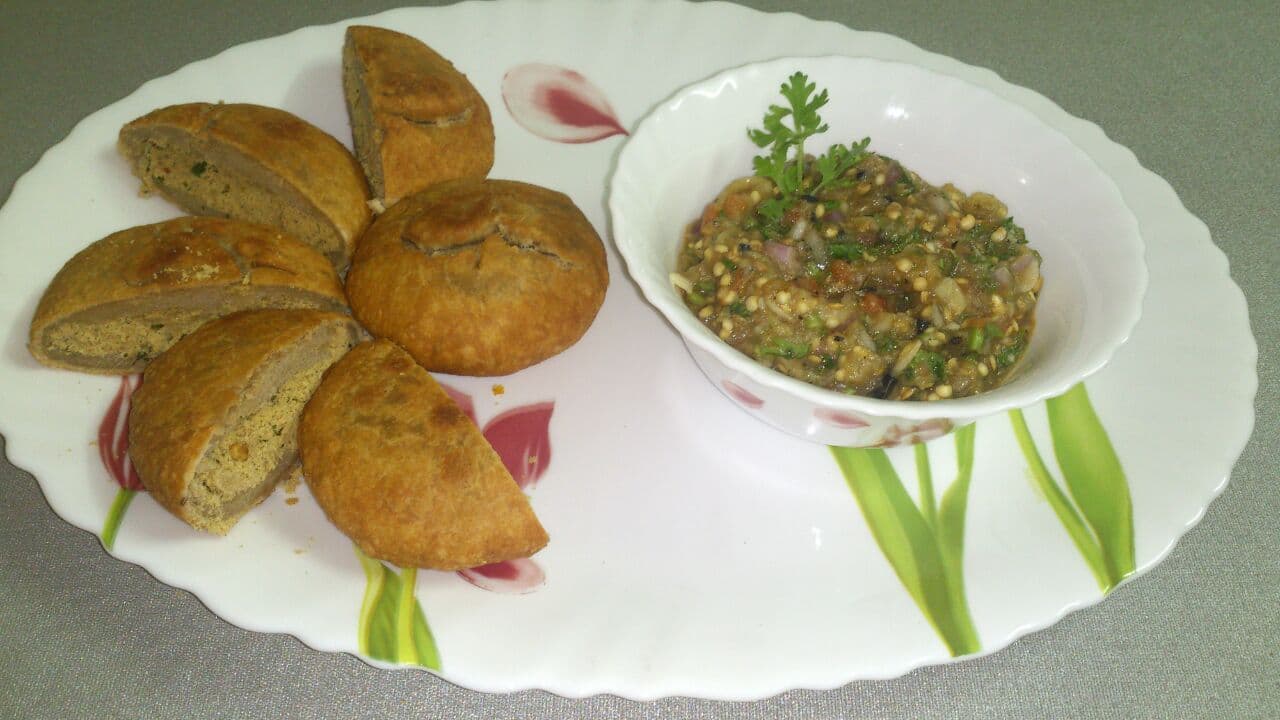
To eat in Purvanchal is to eat with the season. The kitchen tilts towards wheat and mustard oil in winter, towards gram flour and light spice through the hot months, towards milk and seasonal fruit as winter returns. A brief field guide to the dishes you are most likely to meet — and the households they belong to.
Litti-chokha
The region's most recognisable dish. Balls of whole-wheat dough are stuffed with spiced roasted gram flour (sattu), garlic, ajwain, and mustard oil, then cooked over coals or wood until the outside is blistered and the inside fragrant. They are served with chokha — a mash of roasted brinjal, tomato, and potato, seasoned with mustard oil, raw garlic, and green chilli. It is a winter dish, meant for the cold; in summer, it is mostly a dish for travellers and roadside stalls.
Thekua
A deep-fried biscuit made of whole-wheat flour, jaggery, and ghee. Thekua is a Chhath dish above all; its preparation is ritualised, and the women of the household make large batches to be offered at the river and distributed afterwards. Good thekua is dense, slightly chewy at the centre, and keeps for weeks.
Malaiyo
A winter speciality of Varanasi — a cloud-light sweet made by whipping sweetened milk overnight under the dew, which adds air and a particular lightness. The result is more foam than custard, perfumed with cardamom and saffron, and served in small kulhars. Malaiyo is sold from a handful of carts and shops in the old city and vanishes when the weather warms.
Kachori-sabzi
A morning dish. Round, deep-fried kachoris filled with spiced lentil paste are served with a thin aloo-sabzi and often a dollop of sweet tamarind chutney. The line at a good kachori stand begins at six in the morning. This is everyday eating — the Purvanchali equivalent of a coffee-and-pastry.
Baati
A close cousin of litti, but unstuffed — baked balls of wheat dough cooked in a tandoor or over coals, cracked open and drenched in ghee. Baati is more a western-UP dish in origin but has moved east, and is now common in Gorakhpur and in the eastern districts.
Dal-bhaat-tarkaari
The everyday meal. Rice, lentil, a seasonal vegetable, a green. What varies is the lentil (arhar in summer, masoor in monsoon, chana in winter), the vegetable, and the spicing. It is the meal most Purvanchali households sit down to at night; everything else is a variation on it.
Beyond the named dishes, Purvanchali cooking has its own grammar: the use of mustard oil as a finishing condiment as much as a cooking medium, the quiet but constant presence of ginger and green chilli, the late-stage tempering (tadka) of dals with kalaunji or jeera. Future essays in this pillar will visit individual kitchens — home and professional — and trace these techniques to the people who use them.