
Banarasi Weaves: A Morning in Madanpura
In a narrow lane of the old city, two brothers weave the same sari their grandfather wove. The loom is older than the house.

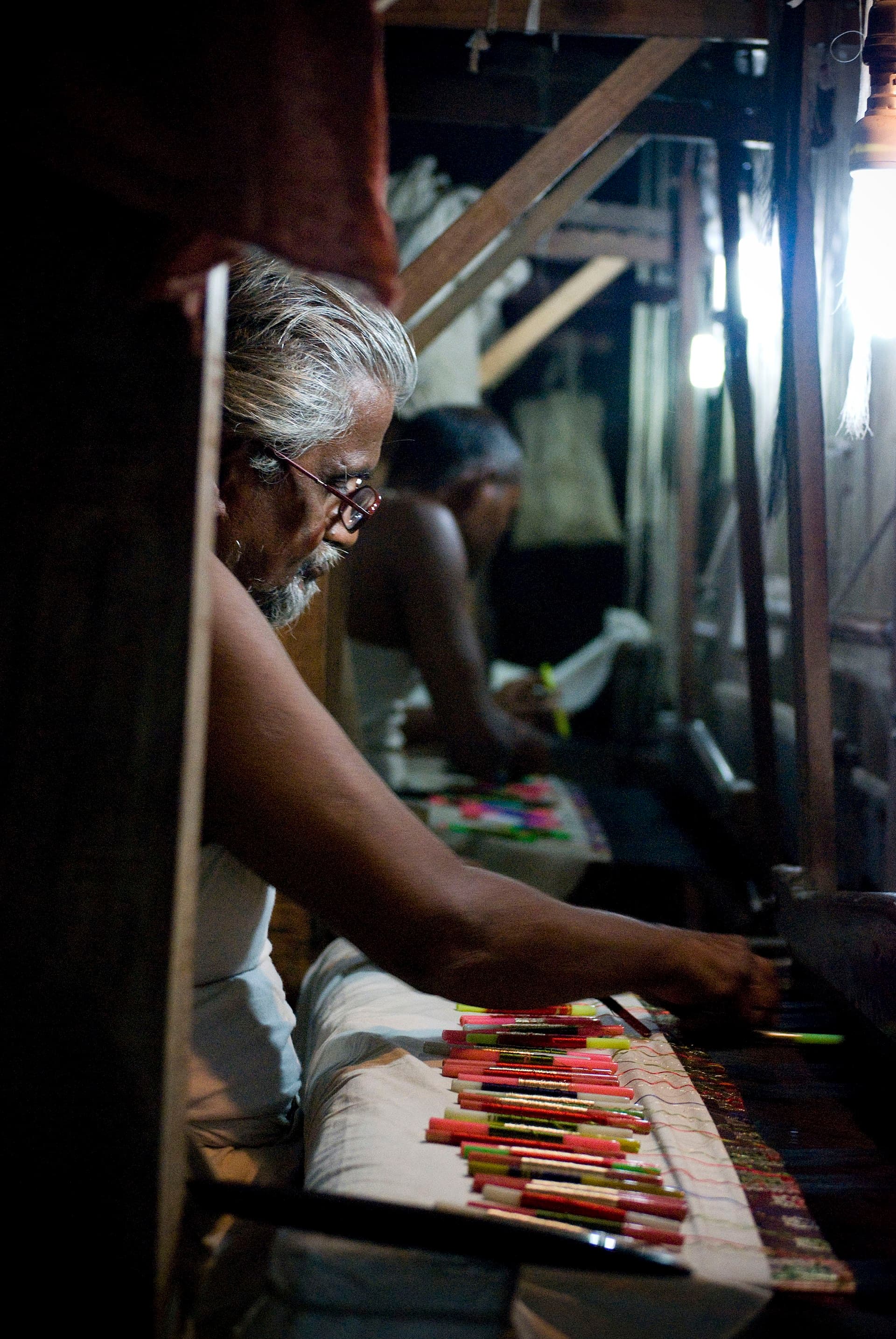
The loom fills the room. It occupies what would otherwise be a living space — the cot is pushed against the wall, the cooking stove is in an alcove behind a curtain, and the loom itself runs almost the full length of the house. Its wooden frame has darkened with decades of hand oil. The warp threads, laid out from the back of the loom through a series of guides, catch the light from the one small window.
Shamshad and Irfan work here together. Shamshad is fifty-one. Irfan is forty-six. They are weaving a sari in the tanchoi style — a technique characterised by an extra weft that runs a satin-weave pattern across a plain silk ground. It is a sari that will, when finished, cost more than the brothers earn in several months.
The Banaras brocade tradition is at least five hundred years old, probably older. The city appears in Mughal-era trade records as a major silk-weaving centre; it was to silk what Ahmedabad was to printed cotton. The distinctive Banarasi motifs — the buti (small flower), the kalga (paisley), the jhallar (border edging) — developed in dialogue with Persian design, Hindu iconography, and the patronage of the Awadh court and later the British.
Today, the weaving community is concentrated in neighbourhoods like Madanpura, Lallapura, Alaipura, and Pilikothi. Most weavers are Muslim, descendants of families who have woven for many generations. The design and marketing are typically handled by a gaddi-dar — a merchant who commissions the sari, supplies the materials, and sells the finished piece.
This arrangement is the source of the craft's most persistent problem. Weavers like Shamshad and Irfan are paid by the piece. A complicated tanchoi sari can take three weeks of continuous work; the rate they are paid has not kept pace with the price the sari fetches in Mumbai or Delhi. Meanwhile, powerloom reproductions — most of them made outside Varanasi, in Surat and elsewhere — flood the mid-market and crowd the handloom weavers out of their own reputation.
The Geographical Indication registration granted to Banarasi sarees in 2009 was meant to help. In practice, enforcement has been weak, and the GI label does little to distinguish a hand-woven sari from a powerloom one at the point of sale.
“It is not that the craft is dying,” Shamshad said, the shuttle going back and forth without a pause as he spoke. “It is that the young people are leaving it. My own son works in Dubai. He doesn't want the loom. I can't blame him.”
And yet: the loom keeps turning. The patterns on the jacquard card feed through the harness; the warp rises and falls; the weft goes through. The sari grows by a few centimetres in an hour. In the next room, a younger weaver — a cousin — is working on a plain silk piece that will be finished by evening. Somewhere behind us, a radio is playing a qawwali.
Much is written about Banarasi weaves in the register of heritage. The reality of the workshop is more practical, and more tender. It is two brothers, a loom, a lane, and the slow accretion of a sari.
- Interviews in Madanpura, Feb 2025 (names changed at weavers’ request)
- Banarasi sari GI registration, Geographical Indications Registry of India, 2009